102 Charles St

Boston, MA 02114

Phone Number

(617) 720-1992

Follow Us:

Professional Trauma Certified Chiropractor in Boston, MA

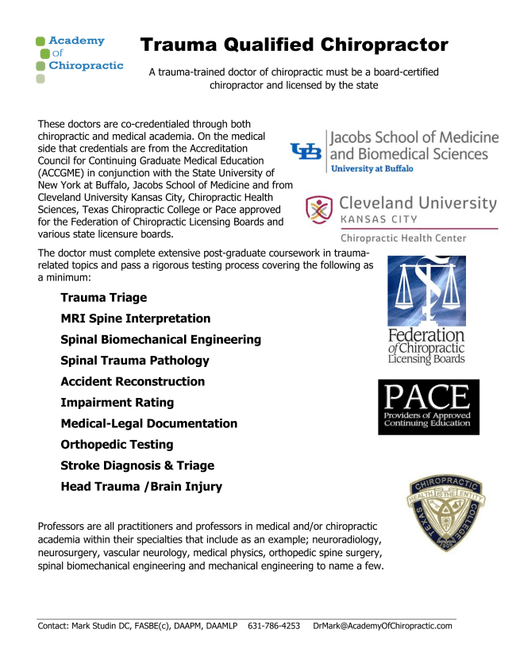
In March of this year, I was certified as a Trauma Qualified Chiropractor by the Academy of Chiropractic. As of this time there were only 135 doctors awarded this certificate in the entire country.

The training is credentialed by the Jacobs School of Medicine and Biomedical Sciences at the University of Buffalo and Cleveland University.

Trauma Qualified Chiropractor

Trauma Qualified Chiropractor Explanation

Picture of Dr. Christopher Quigley

Dr. Christopher Quigley

“I was majoring in chemistry at Villanova University when my path turned to chiropractic. I was going on interviews to be a pharmaceutical sales representative, and they always asked me what I wanted to be doing in five years. My answer was always the same: “I want to be helping people, enjoying my work, while making a difference.”

Book Your Appointment

Get started on your path to optimal health today!

More Valuable Reading

Rear-End Collisions and Long-Term Health Effects: What Boston Attorneys Need to Know

Key Finding: Long-Term Health Complaints Are More Common

The study found that individuals involved in rear-end collisions were more likely to report future health complaints, including:

Chronic neck pain

Persistent headaches

Musculoskeletal discomfort

General health issues

Importantly, these were not always immediate. Many individuals developed or continued to experience symptoms well after the initial event.

For attorneys handling cases in Boston and throughout the Greater Boston Area, this finding necessitates that you account for this fact in your settlement discussions. Your clients are getting a settlement to compensate for a lifetime of potential health problems.

Read More »

The Missing Link in Chronic Whiplash: What MRI Shows About Alar Ligament Injury

In cases throughout Boston and the Greater Boston Area, this scenario is common. Clients report ongoing neck pain, headaches, dizziness, and functional limitations, while the defense relies on unremarkable MRIs to argue “no injury.”

Emerging evidence suggests something critical is often overlooked: alar ligament injury.

A 2015 study by Chen et al. in the Journal of Central South University of Medical Science examined MRI findings in patients with chronic whiplash and suspected alar ligament injury, particularly in older adults—offering a clearer explanation for persistent symptoms and a pathway to stronger causation arguments.

Read More »