
A seat belt can save a life. It can also leave behind an important physical record of the forces involved in a motor vehicle crash.
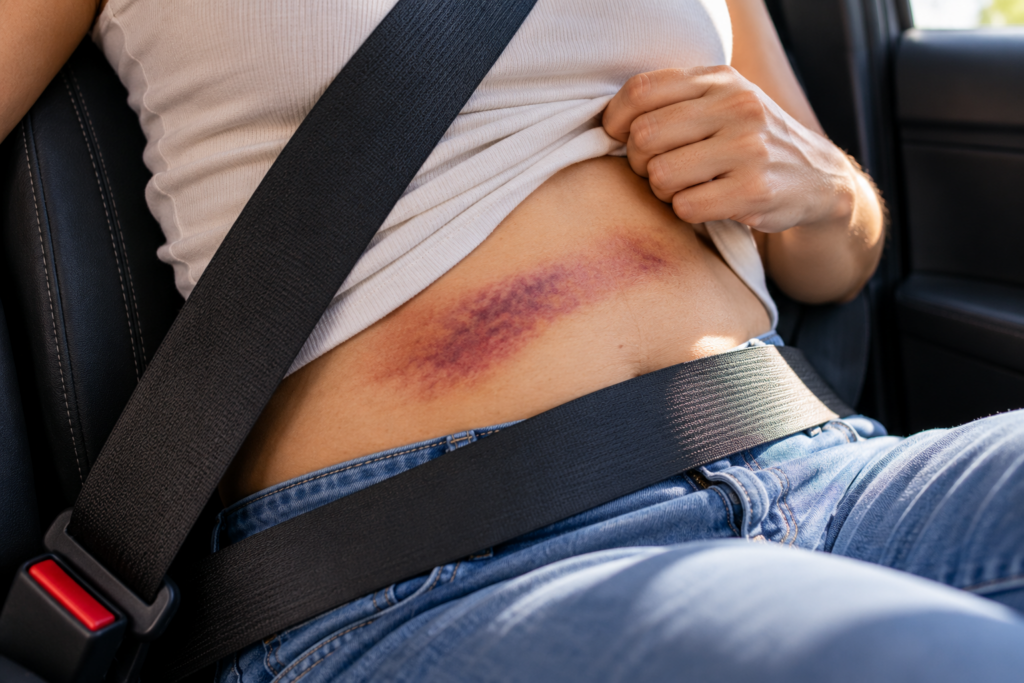
For Boston personal injury attorneys, that record may appear as a seat belt sign—a bruise, abrasion, or patterned injury across the chest, abdomen, flank, or neck corresponding to the position of the restraint.
The significance of that mark extends beyond the skin.
Medical literature has long recognized that restraint forces can be associated with injuries to structures beneath the area of the belt, including the abdominal organs, bowel, mesentery, and spine.
For an attorney evaluating causation, the seat-belt sign deserves careful attention.
An Injury Pattern Recognized for Decades
The medical history of restraint-related injury goes back well before modern airbags and sophisticated crash-protection systems.
In September 1948, G. Q. Chance published “Note on a Type of Flexion Fracture of the Spine” in the British Journal of Radiology. The paper described the flexion-distraction fracture pattern subsequently known as the Chance fracture.
Although Chance’s original paper was not titled a paper about seat-belt injuries, the fracture pattern became closely associated with lap-belt restraint and is an important early example of the medical recognition of injuries produced by restraint forces.
The same basic principle applies to the abdomen: the restraint can stop the occupant’s forward movement while concentrating substantial force across a relatively narrow portion of the body.
The Seat Belt Sign
The 2013 article “Seat Belt Sign and its Significance,” published in the Journal of Family Medicine and Primary Care, described the seat-belt sign as bruising or abrasion associated with the path of the restraint.
The authors emphasized its relationship with potentially serious internal injuries.
The injuries discussed included abdominal and bowel injuries, mesenteric injury, thoracic injury, cervical vascular injury, and thoracolumbar spinal injury.
That makes the external mark important.
The skin may show where the restraint acted on the body even when the most serious injury lies underneath it.
Rutherford’s Unexpected Finding
The history of seat-belt injuries contains an especially interesting observation from Rutherford and colleagues. This was published in 1985 by the Stationary Office and titled: The Medical Effects of Seat Belt legislation in the United Kingdom.
Their 1985 report in the Archives of Emergency Medicine on the medical effects of compulsory seat-belt legislation in the United Kingdom, the authors wrote:
“Following the compulsory use of seatbelts, we predicted an increase in the case of two injuries: sprains of the neck, and fractures of the sternum. Both were confirmed. The other apparent increase in a major injury, which was not predicted, was abdominal injuries of the organs.”
The distinction is important.
The investigators predicted the increase in neck sprains and sternum fractures.
They did not predict the apparent increase in abdominal-organ injuries.
The Bruise May Be the First Clue
A patient may arrive at an emergency department complaining primarily of neck, back, or generalized pain.
The abdominal injury may not initially be the dominant complaint.
That is one reason the physical examination and documentation of the seat-belt sign matter.
A visible abdominal belt mark tells the medical provider—and potentially the later fact finder—that substantial restraint forces were transmitted through that portion of the body.
The mark can therefore be more than a superficial injury. It can be the external evidence of an internal mechanism of injury.
The 2013 medical literature cited a study involving 117 injured patients in which 12 percent had a seat-belt sign, and 64 percent of those patients with the sign had an abdominal injury.
For an attorney, the lesson is straightforward: a documented seat-belt sign should not be treated as cosmetic evidence.
It may warrant careful attention to the underlying medical record and the possibility of internal injury.
What Massachusetts Attorneys Should Preserve
When a seat-belt sign is present, counsel should look for documentation created as close to the collision as possible.
Important evidence can include:
• Photographs showing the belt mark
• EMS photographs or observations
• Emergency-department records
• The exact location and appearance of the bruise or abrasion
• Abdominal tenderness or pain
• Imaging studies
• Diagnoses involving bowel, mesentery, or abdominal organs
• Surgical records
• Documentation of seat-belt use
• Vehicle damage and occupant position
• Was the victim’s head turned?
• Direction of the Impact: Rear-ended is typically worse
• The victim’s state of awareness
• The timing between the collision and the discovery of the injury
The photographs can be particularly valuable.
A photograph taken shortly after the collision can preserve evidence that may fade or disappear long before litigation reaches discovery or trial.
The Causation Significance
In a disputed Massachusetts motor vehicle case, the defense may focus on the absence of immediate severe symptoms or argue that an injury was unrelated to the collision.
The seat-belt sign provides another piece of the factual record.
It establishes that the restraint physically interacted with the occupant’s body during the crash and left an identifiable injury along its path.
When that finding is documented contemporaneously and corresponds with later-diagnosed internal injury, it can become an important part of the causation evidence.
The point is not simply that the victim had a bruise.
The point is that the bruise records where the crash forces were transmitted through the restraint.
The Medical-Legal Takeaway
For Boston personal injury attorneys, the seat-belt sign deserves more attention than it often receives.
It can provide a visible connection between the crash and the forces imposed on the occupant.
A seat-belt bruise is therefore not merely a mark on the skin.
It can be contemporaneous physical evidence of what happened inside the vehicle—and an important piece of evidence when the resulting injury is later disputed.