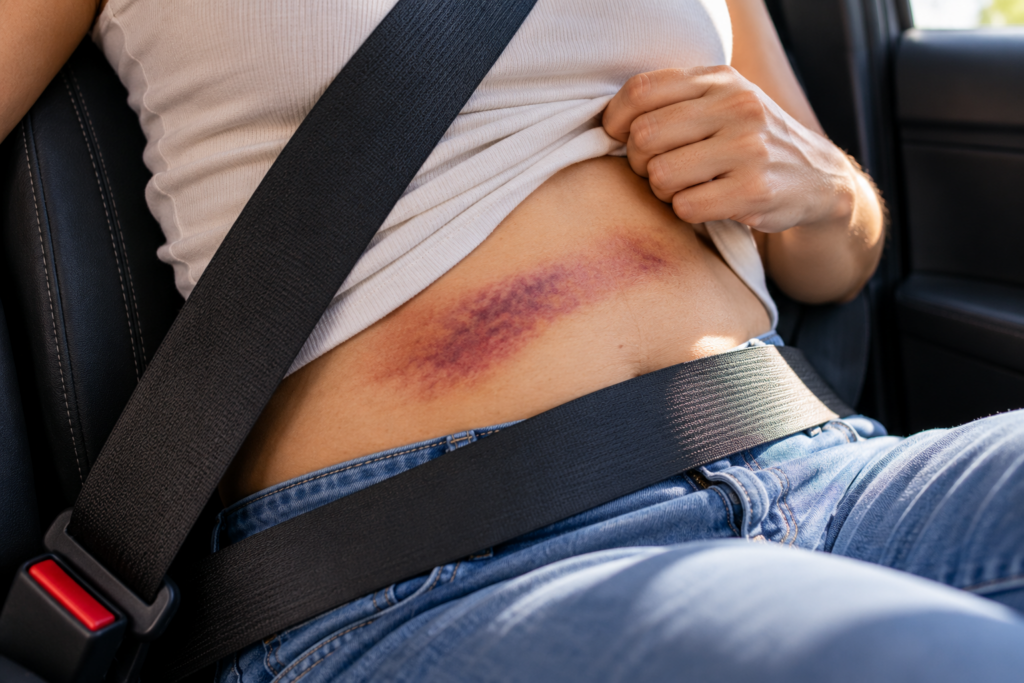


A client is rear-ended in Boston. Days later, the neck pain is accompanied by tingling, numbness, weakness, or pain traveling into the shoulder, arm, or hand.
The defense response may be predictable: “There was no fracture. The imaging isn’t dramatic. How could this collision have affected a nerve?”
A March 2006 biomechanical study published in Spine provides an important piece of that puzzle. Researchers Manohar Panjabi, Travis Maak, Paul Ivancic, and Shigeki Ito investigated what happens to the cervical intervertebral foramina during a simulated rear impact. These openings are critically important because cervical nerve roots and associated neural structures pass through them.
For Boston personal injury attorneys handling whiplash and rear-end collision cases, the findings help explain a mechanism by which an occupant can develop neurological symptoms following a crash.
The Foramen: A Small Space With a Big Job
Between adjacent cervical vertebrae are openings called the intervertebral foramina. Think of them as small doorways through which spinal nerves exit the cervical spine.
If one of those openings becomes sufficiently narrowed, neural structures within the area may be compressed or irritated.
That matters because patients suffering from whiplash can report symptoms such as paresthesia and muscle weakness, which the researchers noted have been associated with neural compression within the cervical intervertebral foramen.
The Panjabi study asked an intriguing question: Could the foramen temporarily narrow during the actual dynamics of a rear impact?
Researchers Simulated Rear-End Impacts
The investigators used six whole cervical-spine specimens with an average age of 70.8 years. Their laboratory model incorporated muscle-force replication and a surrogate head.
The cervical spines underwent simulated rear impacts at 3.5, 5, 6.5, and 8 g, following a noninjurious baseline acceleration of 2 g. Researchers measured dynamic changes in foraminal width, height, and area during the impacts.
This is an important distinction for attorneys.
The study wasn’t simply examining a patient’s neck after an accident. It was investigating what happens to the neural openings during the impact itself.
The Foraminal Openings Actually Narrowed
The researchers documented significant dynamic changes.
At C5-C6, average peak narrowing of foraminal width increased significantly above baseline beginning at the 3.5 g impact. The researchers also found that average peak foraminal area at C4-C5 was significantly narrower than baseline during the 3.5, 5, and 6.5 g impacts. Foraminal height, however, did not demonstrate significant increases in average peak narrowing.
The authors concluded that their extrapolation indicated the greatest potential for dorsal nerve root ganglion1 compression injury was in the lower cervical spine, particularly C5-C6 and C6-C7. They further proposed that acute ganglion compression could produce a sensitized neural response to repeated compression and potentially contribute to chronic radiculopathy following rear impact.
Dr. Panjabi used cadavers in this study. The cadavers lack a active neuromuscular response and this mimic what happens to the unaware crash victim.

Why This Matters in a Boston Whiplash Case
For attorneys, this study illustrates an important concept: a rear-end collision is a dynamic event.
An MRI is generally obtained after the accident, when the patient is lying still. The Panjabi study examined something very different—the dimensions of the cervical foramina while the simulated impact was actually occurring.
Therefore, a later static image does not recreate the transient mechanical conditions that existed during the collision.
That doesn’t mean this laboratory study proves that a particular client’s arm pain was caused by foraminal compression. It does, however, provide a scientifically described biomechanical mechanism that attorneys and medical experts can consider alongside the patient’s history, examination, imaging, neurological findings, and other evidence.
Pre-Existing Degeneration Deserves Attention
Another particularly relevant feature for personal injury litigation is that the researchers specifically considered the potential for nerve root and ganglion impingement in individuals with and without foraminal spondylosis. Dr. Panjabi found that the narrowing is more pronounced and spread to more levels in individuals with foraminal spondylosis, A.K.A. arthritis.
That makes this research especially interesting when an insurance carrier points to pre-existing cervical degeneration as though it automatically excludes traumatic injury.
The clinically important question may not simply be, “Was degeneration present before the crash?”
It may also be, “How did the collision dynamically load a cervical spine that already had reduced space available for its neural structures?”
The study is another great example demonstrating that those with more arthritis and degeneration before the crash have a weaker spine and will suffer more injury with less trauma.
What Boston Personal Injury Attorneys Should Take Away
When representing a client with neck pain, arm pain, numbness, tingling, or weakness after a Boston rear-end collision, don’t evaluate the case solely through the lens of vehicle damage or a static imaging report.
Panjabi and colleagues demonstrated that cervical neural spaces can change dynamically during simulated rear impact, with particularly important findings involving the lower cervical spine.
For attorneys handling Boston car accident, whiplash, cervical radiculopathy, and personal injury cases throughout Massachusetts, this research can help explain why the biomechanics occurring in milliseconds during a collision may matter long after the vehicles have stopped moving.
At Charles Street Family Chiropractic, Dr. Chris Quigley works with patients and attorneys throughout Boston, Beacon Hill, Back Bay, Cambridge, Brookline, Newton, Somerville, Quincy, and Greater Boston to evaluate and document spinal injuries following motor vehicle collisions.
We are Boston’s Car Crash Experts.
For questions about the clinical and biomechanical aspects of a motor vehicle injury case, contact Dr. Quigley at 617-720-1992.
Reference
1. A spinal ganglion—also called a dorsal root ganglion—is a small cluster of sensory nerve cell bodies located on the dorsal (back) root of each spinal nerve. Part of the peripheral nervous system, it relays physical sensation signals like pain, touch, and temperature from the body to the spinal cord. This ganglions are more susceptible to compressive injury due to the lack of covering that the peripheral nerves enjoy.
2. Panjabi MM, Maak TG, Ivancic PC, Ito S. Dynamic intervertebral foramen narrowing during simulated rear impact. Spine (Phila Pa 1976). 2006;31(5). doi:10.1097/01.brs.0000201243.81745.ba.