
Charles Street Family Chiropractic | Boston, Massachusetts
When most people hear the word laser, they picture something from Star Wars, a grocery-store scanner, or perhaps a dermatologist removing a tattoo.
They probably don’t picture mitochondria.
But maybe they should.
Researchers have spent decades studying how specific wavelengths of red and near-infrared light interact with human cells. The treatment has been called low-level laser therapy (LLLT) and, increasingly, photobiomodulation (PBM).
A fascinating scientific review published in PM&R examined the potential role of this technology in rehabilitation and neurological conditions. And for Boston patients, there’s an interesting local connection: several of the researchers were based right here at Massachusetts General Hospital and Harvard Medical School.
This Isn’t a “Heat Up the Tissue” Treatment
One of the first things to understand about low-level laser therapy is what it doesn’t do.
Unlike surgical lasers designed to cut or destroy tissue through heat, the therapeutic lasers discussed in this paper use light to stimulate biological responses. The authors describe wavelengths from 632 to 1064 nanometers and explain that the treatment works through photochemical rather than thermal effects. 635 nanometers is one of the most researched wavelengths.
In other words, we’re not trying to cook anything.
We’re trying to influence cellular biology with light.
Meet Your Mitochondria
Remember mitochondria from high-school biology?
They’re often called the powerhouses of the cell, because they help produce adenosine triphosphate, or ATP—the energy currency cells use to perform their jobs.
The review describes mitochondria as important photoreceptors for red and near-infrared light. A mitochondrial enzyme called cytochrome c oxidase (CCO) appears to be particularly important.
When appropriate wavelengths of light interact with this system, research described in the review found changes including increased mitochondrial activity and increased ATP production.
Think of ATP as cellular spending money.
Repairing tissue, maintaining cellular function and carrying out biological processes all require energy.
No ATP?
Your cells are essentially standing at the checkout counter with an empty wallet.
It’s More Than ATP
The proposed effects don’t stop there.
The authors describe changes involving nitric oxide, reactive oxygen species, intracellular calcium and cellular signaling pathways. These initial reactions may activate transcription factors that influence genes associated with protective, antioxidant, anti-apoptotic and proliferative responses.
The review also discusses effects on protein production, DNA and RNA synthesis, cellular metabolism, cytokines and growth factors. Importantly, the researchers acknowledge that the exact mechanisms remain incompletely understood.
That’s an important point.
Laser therapy isn’t magic.
It’s photobiology—and researchers are still determining exactly how to optimize it.
The Dose Matters
Here’s another interesting part of the research:
More laser isn’t necessarily better.
The authors describe a biphasic dose response. Increasing the power density or treatment time beyond an appropriate range may actually produce less benefit than a lower dose.
That’s one reason laser therapy isn’t simply about buying a bright red gadget online and pointing it at wherever you hurt.
Wavelength, power, energy delivered, treatment duration, pulsing and the tissue being treated all matter.
What About Nerves?
This review becomes particularly interesting when discussing the nervous system.
The authors reviewed experimental and clinical research involving peripheral nerve injuries. They cited a double-blind randomized pilot study in which 780-nm laser phototherapy following repair of a nerve defect was associated with an increased number of myelinated axons. They also cited research reporting significant functional recovery in patients with long-term peripheral nerve injury following 780-nm laser therapy.
Animal studies discussed in the paper also investigated photobiomodulation for spinal cord injury, reporting increased axonal growth and functional improvements under specific experimental conditions.
These findings don’t mean laser therapy can regenerate every damaged nerve in a patient. Much of this research was experimental, and specific findings shouldn’t be generalized to every condition.
But they help explain why photobiomodulation continues to attract attention in rehabilitation medicine.
What About the Brain?
The paper also reviews early research involving stroke and traumatic brain injury (TBI).
In experimental TBI models, particular red and near-infrared wavelengths were associated with improved neurological performance. The authors also described two human chronic mild-TBI cases treated with transcranial red and near-infrared LEDs in which improvements in cognition were reported.
Those human findings were extremely preliminary—two cases are not enough to establish effectiveness—and the authors specifically called for additional controlled trials.
That’s an important distinction when discussing promising research with patients.
Multiple Lasers at Charles Street Family Chiropractic in Boston
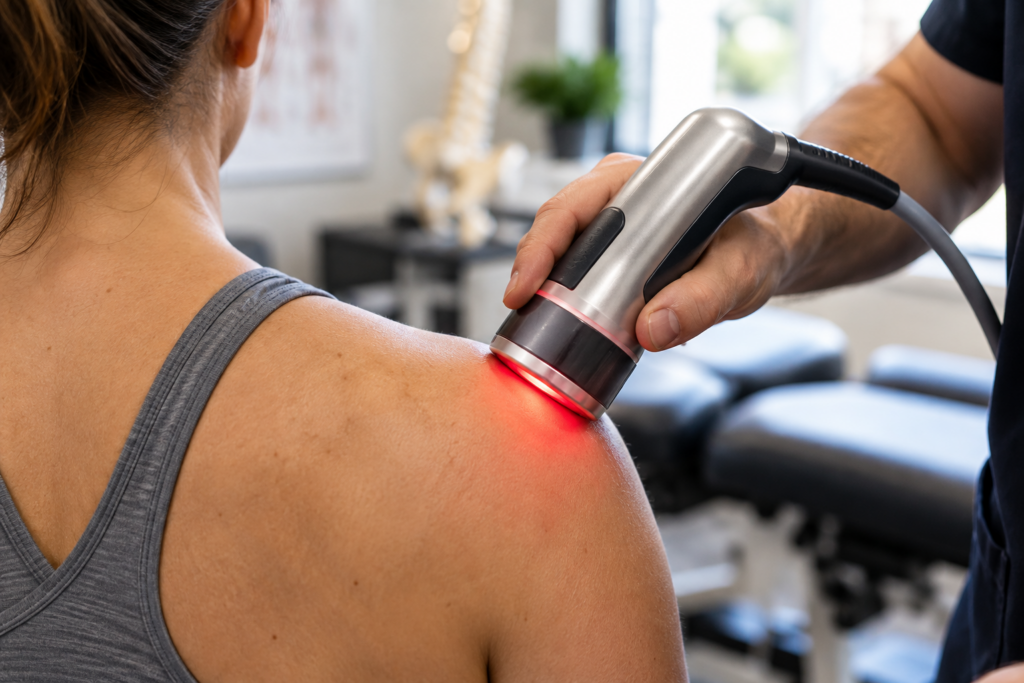
At Charles Street Family Chiropractic in Boston, laser therapy isn’t something we simply read about.
We have multiple therapeutic lasers on site.
Why multiple lasers?
Because laser therapy isn’t one-size-fits-all. Different equipment and treatment parameters can be useful when addressing different tissues, depths and therapeutic objectives.
We may incorporate laser therapy into a broader treatment program when clinically appropriate, alongside chiropractic care and other rehabilitation approaches.
The goal isn’t to chase symptoms with a fancy light.
It’s to use technology as part of an individualized treatment strategy designed around the patient.
The Future of Rehabilitation May Be Brighter—Literally
Hashmi and colleagues concluded that low-level laser therapy was moving increasingly into mainstream medicine and emphasized its potential applications involving both the central and peripheral nervous systems.
More than a decade later, the broader field is commonly called photobiomodulation, but the central concept remains fascinating:
Specific wavelengths of light can interact with cellular machinery and influence biological activity.
If you’re dealing with a musculoskeletal or nerve-related condition and wondering whether laser therapy could be incorporated into your care, we’d be happy to discuss it.
Contact Charles Street Family Chiropractic in Boston to schedule an evaluation and learn whether laser therapy may be appropriate for your condition.
Reference
Hashmi JT, Huang YY, Osmani BZ, Sharma SK, Naeser MA, Hamblin MR. Role of Low-Level Laser Therapy in Neurorehabilitation. PM&R. 2010;2(12 Suppl 2):S292-S305. doi:10.1016/j.pmrj.2010.10.013.