
If you’ve ever experienced a cervical disc herniation, you know that neck pain can be only the beginning. A damaged disc in your neck can irritate or compress a nerve, potentially producing pain down the arm, numbness, tingling, weakness, and significant limitations in everyday activities.
A recently published 2026 case study provides an exciting look at what happened when researchers used cervical non-surgical spinal decompression in a patient with a significant cervical disc herniation. The results included improvements not only in symptoms, but also in neurological examination findings and MRI measurements.
From Active and Healthy to Pain, Weakness and Disability
The patient was a 35-year-old woman who regularly exercised five days per week. Her injury occurred while lifting a 30-pound ball over her shoulder with her neck rotated and laterally flexed.
She immediately experienced sharp neck pain.
Things quickly got worse.
Her symptoms eventually reached 9 out of 10 pain, with burning and stabbing pain, progressive weakness, visible muscle atrophy, and difficulty performing normal daily activities. Strength on the affected side dropped to 3/5, sensation was decreased throughout the arm, and several reflexes were absent. Her Neck Disability Index (NDI) was 36 out of 50, indicating severe disability.
MRI demonstrated disc abnormalities at multiple cervical levels, with the most significant lesion at C5-C6. The case was particularly complicated because the patient also had multiple sclerosis, including a demyelinating lesion at the same level.
Enter Non-Surgical Spinal Decompression
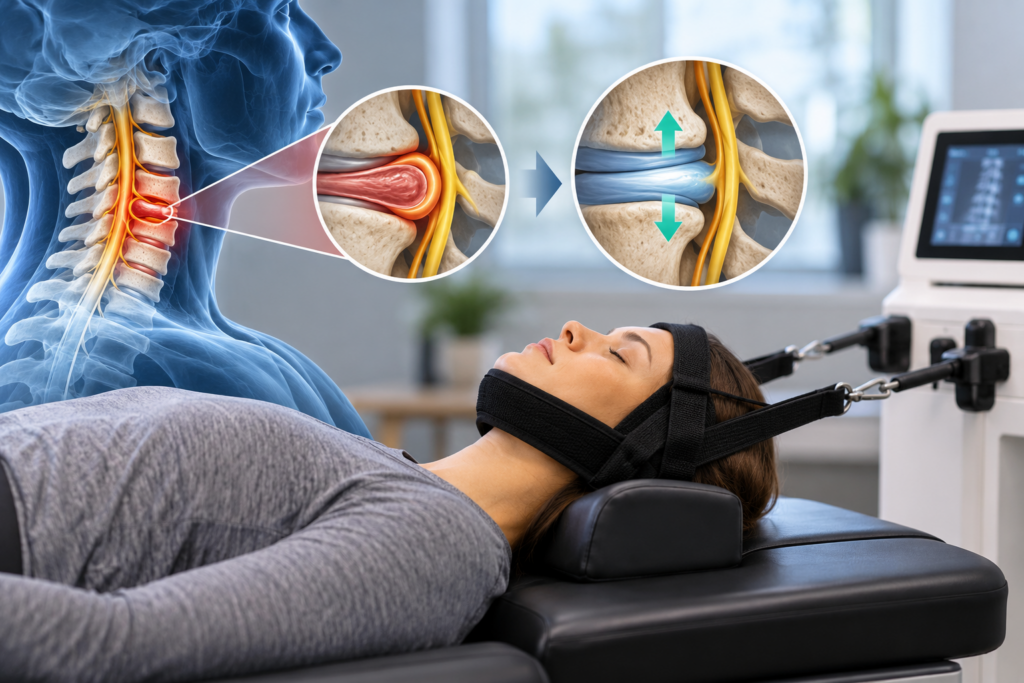
Rather than undergoing surgery, the patient received a course of 20 cervical non-surgical spinal decompression treatments over 15 weeks.
This type of treatment uses controlled, intermittent traction directed toward a specific region of the cervical spine. In this case, treatment was targeted to C5-C6 at a 13-degree angle. Each treatment lasted approximately 28 minutes, with the treatment force gradually increased according to the patient’s tolerance.
And then something impressive happened.
By Treatment #5, Her Radicular Symptoms Were Gone
After approximately 2½ weeks and only five treatments, the patient reported that her radicular symptoms had disappeared and she had returned to normal activities of daily living.
She could once again carry grocery bags with both arms without pain.
Following completion of treatment:
-
Pain decreased to 0/10
-
Muscle strength improved to 5/5
-
Sensation returned to normal
-
Reflexes normalized
-
NDI improved from 36/50 to just 1/50
Those are impressive clinical changes. But the researchers didn’t stop at asking whether the patient felt better.
They looked at the MRI.
The MRI Changes Are Fascinating
At C5-C6, the anterior-posterior measurement of the disc lesion decreased from 5.45 mm to 3.78 mm—a 31% reduction.
Even more interesting, the space available in the spinal canal at the lesion increased from 3.55 mm to 6.70 mm—an 89% increase.
The left foraminal space—the opening through which the affected cervical nerve exits—increased by 45%.
In other words, this wasn’t simply a case of someone saying, “My neck feels better.” The authors reported measurable changes on follow-up imaging along with substantial clinical improvement.
What Happened One Year Later?
Here’s another exciting part of the case.
At the one-year follow-up, the patient’s strength remained normal, sensation and reflexes remained intact, and her Neck Disability Index had improved further to 0/50.
The anterior-posterior measurement of the lesion remained 35% smaller than before treatment, while the increased space on the symptomatic side remained substantially improved.
That makes this case particularly interesting because the improvements weren’t limited to what happened immediately after treatment.
Could Cervical Spinal Decompression Help Your Neck?
There is an important limitation: this is a case study involving one patient, not a large randomized clinical trial. It cannot prove that everyone with a cervical disc herniation will experience similar results. The authors themselves emphasize the need for additional research.
But the findings are certainly intriguing.
For patients struggling with a cervical disc herniation, neck pain, arm pain, numbness, tingling, or weakness, non-surgical spinal decompression may be worth discussing as part of a comprehensive conservative treatment plan.
The key is determining what is actually causing your symptoms and whether you’re an appropriate candidate for this type of care.
At Charles Street Family Chiropractic, we evaluate patients individually to determine whether non-surgical spinal decompression may be appropriate for their condition.
A cervical disc herniation doesn’t automatically mean surgery. There may be a conservative option worth exploring.
Call Charles Street Family Chiropractic at 617-720-1992 to schedule an evaluation.
Reference
Connolly JA, Gabro AM, Welsh S, Bexley J, Schilaty ND. Cervical Non-Surgical Spinal Decompression for Disc Herniation in a Patient with Multiple Sclerosis: A Case Study. Journal of Physical Medicine and Rehabilitation. 2026;8(1):31–38.