


For attorneys handling motor-vehicle collision cases, few injuries generate more debate than whiplash. The vehicle may show relatively modest damage, imaging may be unremarkable, and yet the client continues to report significant neck pain, headaches, stiffness, or neurological symptoms.
One of the best whiplash review articles was published in the British Journal of Bone and Joint Surgery in July of 2009. The review by Bannister, Amirfeyz, Kelley, and Gargan provides several important points for understanding these cases. The article has 100 references. Dr.’s Bannister and Gargan are probably the most published individuals in history on long-term recovery outcomes of whiplash injuries.
Most Whiplash Injuries Occur at Surprisingly Low Speeds
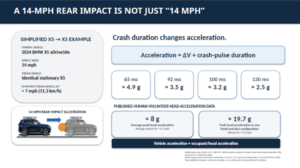
Perhaps the most important observation for attorneys is this: most whiplash injuries occur in rear-end collisions at speeds below 14 mph.
That is important when an insurer attempts to equate relatively minor vehicle damage with an inability to sustain injury. The medical literature recognizes whiplash injury occurring in precisely the type of lower-speed rear-end collision that may produce limited property damage.
Vehicle damage and human injury are not interchangeable measurements.
The cervical spine is subjected to rapid acceleration and complex relative motion between the head and torso. Biomechanical research describes an early loss of cervical lordosis followed by formation of an S-shaped cervical curve, with the lower cervical vertebrae extending before the upper cervical spine, followed later by extension of the entire neck. These early motions may strain structures including the cervical facet joint capsules.
Whiplash Is More Than “Just a Sore Neck”
Bannister and colleagues describe a constellation of symptoms following whiplash, including neck pain and stiffness, occipital headaches, thoracolumbar back pain, upper-extremity pain, and paresthesia or tingling.
This matters when evaluating causation and damages. A client’s complaints involving headaches, arm symptoms, or back pain following a rear-end collision should not automatically be dismissed as unrelated simply because the term whiplash is commonly associated with the neck.
Most Recover—but Not Everyone Does
The prognosis statistics in the Bannister review are particularly useful. The authors reported that more than 66% of patients make a full recovery, while approximately 2% become permanently disabled.
Those numbers tell an important story. The fact that most people recover does not mean that every patient should recover. A minority develops serious, persistent problems.
Perhaps even more significant for attorneys is the authors’ statement that outcome can be predicted in approximately 70% of patients after three months. Earlier prospective research by Gargan and Bannister helps put that three-month milestone into perspective: among patients who remained symptomatic three months after a rear-end collision, 86% were still symptomatic two years later. Conversely, 14 of 15 patients who were asymptomatic at three months remained symptom-free at two years.
Normal Imaging Does Not Necessarily Mean No Injury
Another challenge in whiplash litigation is the absence of dramatic findings on conventional imaging. Whiplash frequently involves soft tissues, and biomechanical research notes that the injury is not necessarily accompanied by obvious tissue damage detectable on standard X-ray or MRI. This is the most important reason to use an expert in evaluating and imaging these patients.
Consequently, the medical analysis should extend beyond the question, “Is there a dramatic MRI abnormality?” Clinical history, mechanism of injury, neurological findings, range of motion, symptom progression, functional limitations, response to treatment, and consistency of the medical record can all become important pieces of the causation analysis.
The Takeaway for Attorneys
The Bannister review provides a useful counterpoint to several common assumptions surrounding whiplash claims.
Low-speed does not mean no injury. Normal imaging does not necessarily mean no injury. And while most patients recover, a meaningful minority do not.
When symptoms persist beyond the initial weeks—and particularly beyond three months—the medical history deserves careful attention.
For attorneys evaluating a complicated whiplash case, understanding the biomechanics, clinical presentation, prognosis, and medical literature can make the difference between viewing a case as “minor neck pain” and recognizing a potentially significant cervical injury.
At Charles Street Family Chiropractic, Dr. Chris Quigley has extensive experience evaluating patients following motor-vehicle collisions and explaining the clinical and biomechanical issues involved in whiplash injuries.
Reference
Bannister G, Amirfeyz R, Kelley S, Gargan M. Whiplash injury. Journal of Bone Joint Surgery Br. 2009;91(7):845–850. doi:10.1302/0301-620X.91B7.22639. PMID: 19567844.